Im Tanz der Frauen

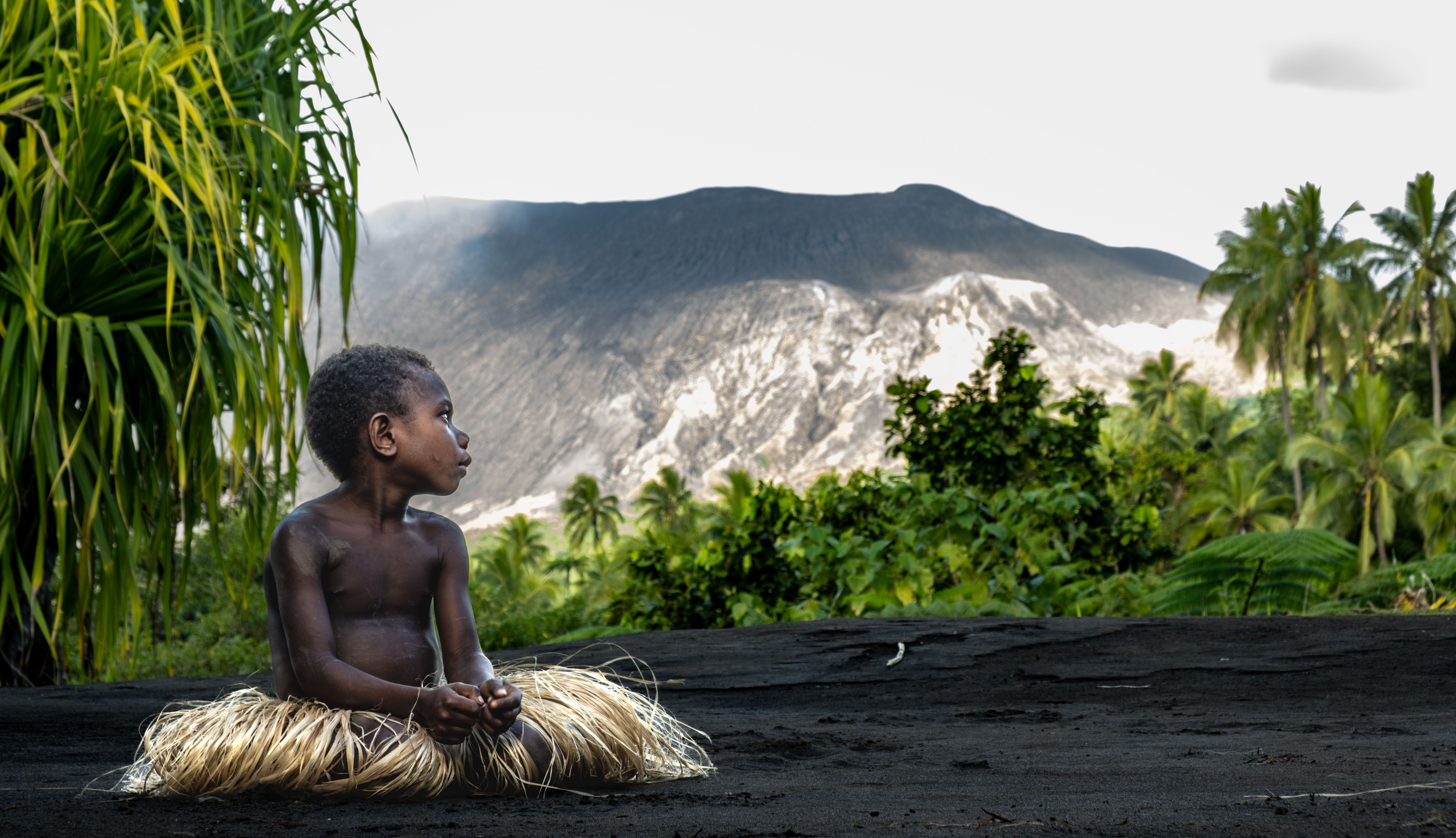
Die Frauen des Dorfes positionieren sich auf dem Tanzplatz für den Willkommenstanz ihrer Gäste. Im Hintergrund erhebt sich der aktive Vulkan Mount Ysaur. In den Händen halten sie ein geflochtenes, beutelartiges Instrument, das mit natürlichen Materialien wie Gras gefüllt ist und bei den Tänzen durch rhythmisches Klatschen verwendet wird. Dazu wird gesungen und in verschieden Formationen getanzt. Oft sind auch Kinder an diesen Tänzen beteiligt.
Zu sehen ist ebenfalls ihre traditionelle Bekleidung: Grasröcke, die sowohl den Ober- als auch den Unterkörper der Frauen bedecken. Dies war jedoch nicht immer so. Noch vor der Missionierung Vanuatus im 19. Jahrhundert trugen die meisten Inselbewohner ihre Grasröcke nur am Unterkörper, der Oberkörper blieb unbedeckt.
Mit dem Einfluss des Christentums, das im 19. Jahrhundert von westlichen Missionaren nach Vanuatu gebracht wurde, gelangten westliche Werte zu Anstand, Scham und Moral auf die Inseln. Dies führte auch zu einer Veränderung der Kleiderordnung der Einheimischen. So wurden Grasröcke angefertigt, um die “Scham” des Oberkörpers der Frauen zu bedecken.
Kastom, Tanz und Zeremonien: Die lebendige Willkommenskultur in Vanuatu
In Vanuatu beschreibt der Begriff kastom ein breites System von sozialen Praktiken, Wissen, Ritualen und Werten, das sich durch Alltag, Politik und zeremonielle Handlungen zieht. Kastom ist dabei kein festes Regelwerk, sondern ein dynamisches Konzept, das sich historisch durch Austausch, Kolonialgeschichte und lokale Neuinterpretation ständig verändert hat.
Zentrale Ausdrucksformen von kastom sind Tänze und rituelle Willkommenszeremonien, die in vielen Gemeinschaften eine wichtige Rolle bei der Herstellung sozialer Beziehungen spielen. Tanz ist nicht nur eine kulturelle Darstellung, sondern ein Mittel zur Kommunikation von Identität, sozialer Ordnung und Zugehörigkeit. Bewegungen, Rhythmen und Gesänge tragen dabei über Generationen weitergegebenes Wissen und markieren die Verbindung zwischen Menschen, Ort und Geschichte.

Willkommenszeremonien sind in vielen Regionen Vanuatus eng mit der Begrüßung von Gästen, der Herstellung sozialer Beziehungen zwischen Gruppen sowie der Einbettung von Außenstehenden in lokale soziale Ordnungen verbunden. Solche Rituale können unterschiedliche Formen annehmen, beinhalten jedoch häufig gemeinschaftliche Versammlungen, musikalische Elemente und Zeremonien, die den sozialen Zusammenhalt stärken.
In der Forschung wird kastom als performative Praxis beschrieben: Es existiert nicht nur als abstrakte Tradition, sondern wird aktiv durch Rituale wie Tanz, Zeremonien und gemeinschaftliche Feste „gemacht“ und bestätigt. Diese Praktiken sind zugleich flexibel und stabil – sie bewahren kulturelle Kontinuität, während sie sich gleichzeitig an neue soziale und historische Bedingungen anpassen. Besonders deutlich wird dies in Zeremonien, die den sozialen Zusammenhalt stärken und in denen Gemeinschaft immer wieder neu hergestellt wird.
Soziale Bedeutung in zeremoniellen Praktiken
Besonders in zeremoniellen Kontexten zeigen Tänze und Willkommensrituale auch die Rolle von Gemeinschaftsstrukturen und Autoritätssystemen. Sie dienen dazu, soziale Beziehungen sichtbar zu machen, Hierarchien zu bestätigen oder auszugleichen und kollektive Identität zu stärken. In diesem Sinn sind sie zentrale Elemente der sozialen Organisation in Vanuatu.
Insgesamt verdeutlichen wissenschaftliche Studien, dass kastom nicht als statische „Tradition“ verstanden werden kann, sondern als ein lebendiges System, das durch performative Praktiken wie Tanz und Zeremonie immer wieder neu hergestellt wird.

Lindstrom, Lamont (1994): Kastom as Discourse: The Politics of Cultural Identity in Vanuatu. In: Kastom and Culture in Melanesia, University of Hawaii Press.
Jolly, Margaret (1994): Women of the Place: Kastom, Colonialism, and Gender in Vanuatu. Harwood Academic Publishers.
Bonnemaison, Joel (1994): The Tree and the Canoe: History and Ethnogeography of Tanna. University of Hawaii Press.
The Dance of Women
The women of the village take their positions on the dancing ground for the welcome dance performed for their guests. Rising in the background is the active volcano Mount Yasur. In their hands they hold a woven, pouch-like instrument filled with natural materials such as grass, which is used during the dances through rhythmic clapping movements. The performances are accompanied by singing and dancing in various formations, and children often take part as well.
Also visible is their traditional clothing: grass skirts that cover both the upper and lower body of the women. This was not always the case. Before the Christian missionary activity in Vanuatu during the 19th century, most island inhabitants wore their grass skirts only around the lower body, while the upper body remained uncovered.
With the influence of Christianity, brought to Vanuatu by Western missionaries in the 19th century, Western ideas about decency, shame, and morality reached the islands. This also led to changes in the clothing customs of the local population. Grass garments were then made to cover what missionaries regarded as the “modesty” of women’s upper bodies.
Kastom, Dance, and Ceremonies: The Living Culture of Welcome in Vanuatu
In Vanuatu, the term kastom describes a broad system of social practices, knowledge, rituals, and values that permeates everyday life, politics, and ceremonial activities. Kastom is not a fixed set of rules, but a dynamic concept that has continuously evolved through historical exchange, colonial experiences, and local reinterpretation.
Central expressions of kastom include dance and ritualized welcoming ceremonies, which play an important role in many communities in shaping and maintaining social relationships. Dance is not only a cultural performance but also a means of communicating identity, social order, and belonging. Movements, rhythms, and songs carry knowledge passed down through generations and express the connection between people, place, and history.
Welcoming ceremonies in many regions of Vanuatu are closely tied to the reception of guests, the establishment of relationships between groups, and the integration of outsiders into local social structures. These rituals can take different forms but often include communal gatherings, musical elements, and ceremonies that strengthen social cohesion.
In academic research, kastom is often described as a performative practice: it does not exist only as an abstract tradition but is actively “made” and reaffirmed through rituals such as dance, ceremonies, and community celebrations. These practices are both flexible and stable—they preserve cultural continuity while also adapting to new social and historical conditions. This is particularly evident in ceremonies that reinforce social cohesion and in which community itself is continually recreated.
Social Meaning in Ceremonial Practice
In ceremonial contexts, dances and welcoming rituals also reflect community structures and systems of authority. They make social relationships visible, reinforce or balance hierarchies, and strengthen collective identity. In this sense, they are central elements of social organization in Vanuatu.
Overall, scholarly studies show that kastom cannot be understood as a static “tradition,” but rather as a living system that is continuously recreated through performative practices such as dance and ceremony.
Lindstrom, Lamont (1994): Kastom as Discourse: The Politics of Cultural Identity in Vanuatu. In: Kastom and Culture in Melanesia, University of Hawaii Press.
Jolly, Margaret (1994): Women of the Place: Kastom, Colonialism, and Gender in Vanuatu. Harwood Academic Publishers.
Bonnemaison, Joel (1994): The Tree and the Canoe: History and Ethnogeography of Tanna. University of Hawaii Press.